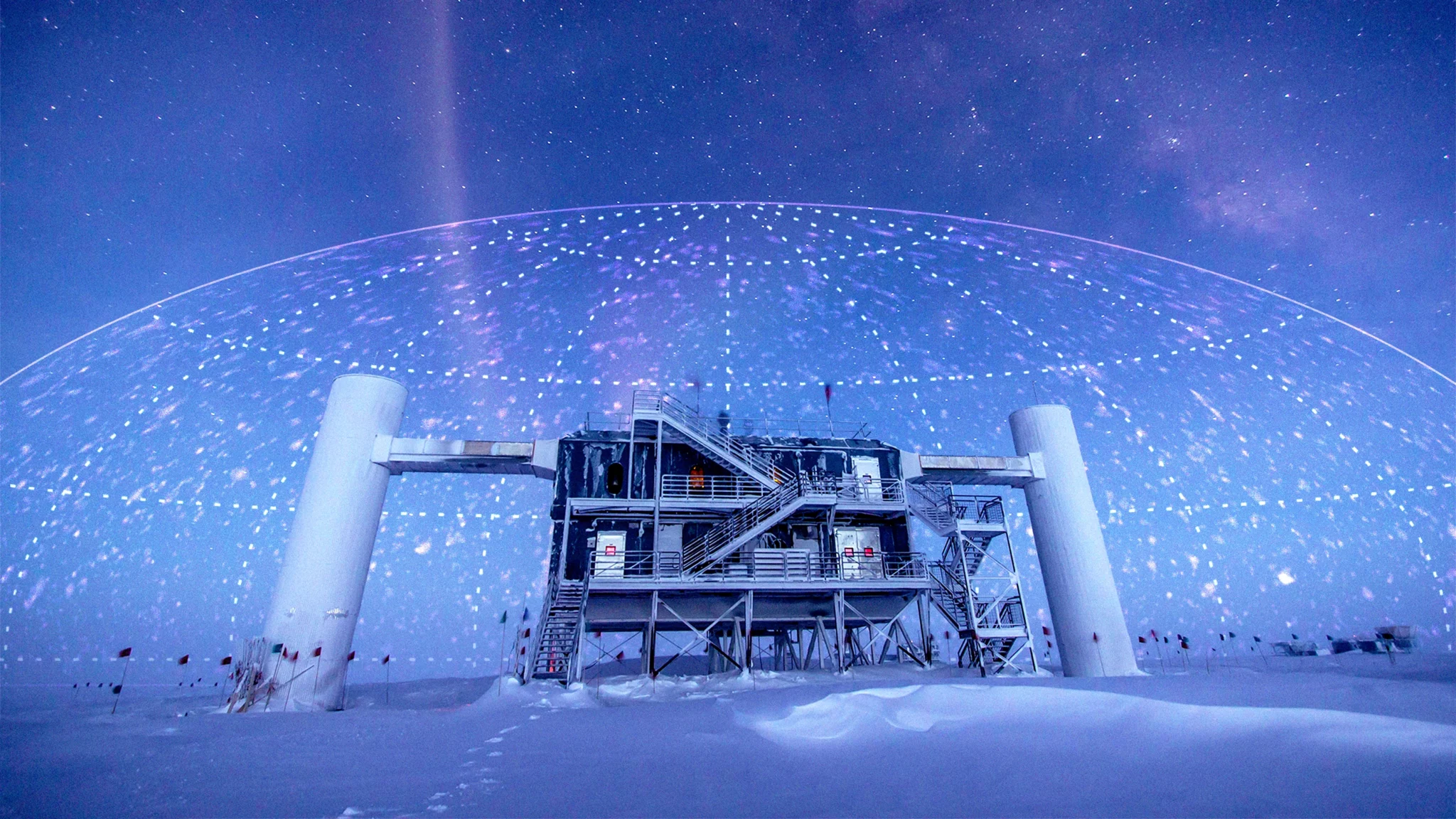
The question is no longer whether neutrinos exist, or even whether they interact. It is how much of their silent, constant motion can be transformed into measurable energy. For decades, this idea remained theoretical. Then came data. From the detectors of Japan’s Super-Kamiokande to the frozen array of IceCube in Antarctica, from the CEνNS results at Oak Ridge to the spectral precision of JUNO in southern China, a continuous chain of proof emerged. What once looked abstract became observable. And from that chain, a new equation was born.
News
The first clear insight often takes shape in silence. Deep rock, deep water, and deep time frame the latest effort to understand a particle that reaches Earth from every direction. Two new facilities, JUNO in Guangdong and KM3NeT in the Mediterranean, now supply fresh data that sharpen long-standing questions about neutrino mass, flavor transitions, and the engines that drive high-energy particle streams across the cosmos.
When tracing the path of scientific progress, the temptation is always to draw a single line, to name a discovery, a company, or a visionary and stop there. Yet real breakthroughs rarely obey such simplicity. They emerge from a lattice of connections, built from countless experiments, calculations, and the quiet persistence of people who may never meet.
The excitement surrounding artificial intelligence often emphasizes breakthroughs in natural language processing, image recognition, and decision-making systems. What receives less attention is the physical foundation required to sustain these technologies: electricity. Servers, cooling systems, and transmission lines form the indispensable scaffolding of AI. Without reliable and affordable power, progress in artificial intelligence becomes unsustainable. The discussion is not only about technology but about infrastructure and its limits.
In the complex calculus of the global energy transition, one question stands at the center: what power source can guarantee continuity? As governments dismantle coal fleets, as oil peaks and grids fragment under renewable intermittency, the hunt for truly constant, sustainable energy grows urgent.
When the Iberian Peninsula went dark, it wasn’t a weather anomaly, cyberattack, or system hack that triggered chaos—it was the grid itself. One of Europe’s most advanced renewable energy regions lost 15 GW in just five seconds, halting airports, collapsing public transit, and leaving millions without direction. But this wasn’t a collapse of green energy—it was the collapse of an aging, centralized system struggling to accommodate new realities.
A silent shift in the global tech community often emerges with little fanfare, yet it can have extraordinary implications. Over the last few weeks, a ripple of curiosity has passed through academic halls and corporate R&D hubs, sparked by an unlikely pair of developments on seemingly distant fronts. Microsoft’s unveiling of Majorana 1, a quantum processor built on a Topological Core to possibly accommodate a million qubits, captured headlines for its promise of cracking intractable problems.
For over a century, the world has been bound by an invisible chain—our dependence on centralized energy grids. From the towering power plants of industrial megacities to the sprawling wind farms dotting the countryside, energy generation has remained locked within an outdated framework: mass production, centralized control, and limited accessibility.
The hum of modern life depends on energy, an invisible lifeline that powers our homes, businesses, and societies. Yet, as the world hurtles toward unprecedented energy demands and climate challenges, the reliability and sustainability of our energy sources come into sharp focus.
As the wind subsides and the sky turns an unbroken shade of gray, a quiet stillness blankets the landscape. It’s not the kind of peace that brings comfort, but rather one that signals a looming challenge. Across fields where turbines once turned and rooftops where panels basked in the sun, this stillness reveals the fragility of modern energy systems. A single word—Dunkelflaute—captures this unsettling phenomenon, one that Germany and its neighbors now know all too well. Yet this moment of vulnerability is not isolated to one nation; it serves as a microcosm of a global reckoning with energy dependency, resilience, and sustainability.