
Energy 11 min read
How Much Power Does AI Really Need, and Why Are We Still Squeezing the Earth to Find It
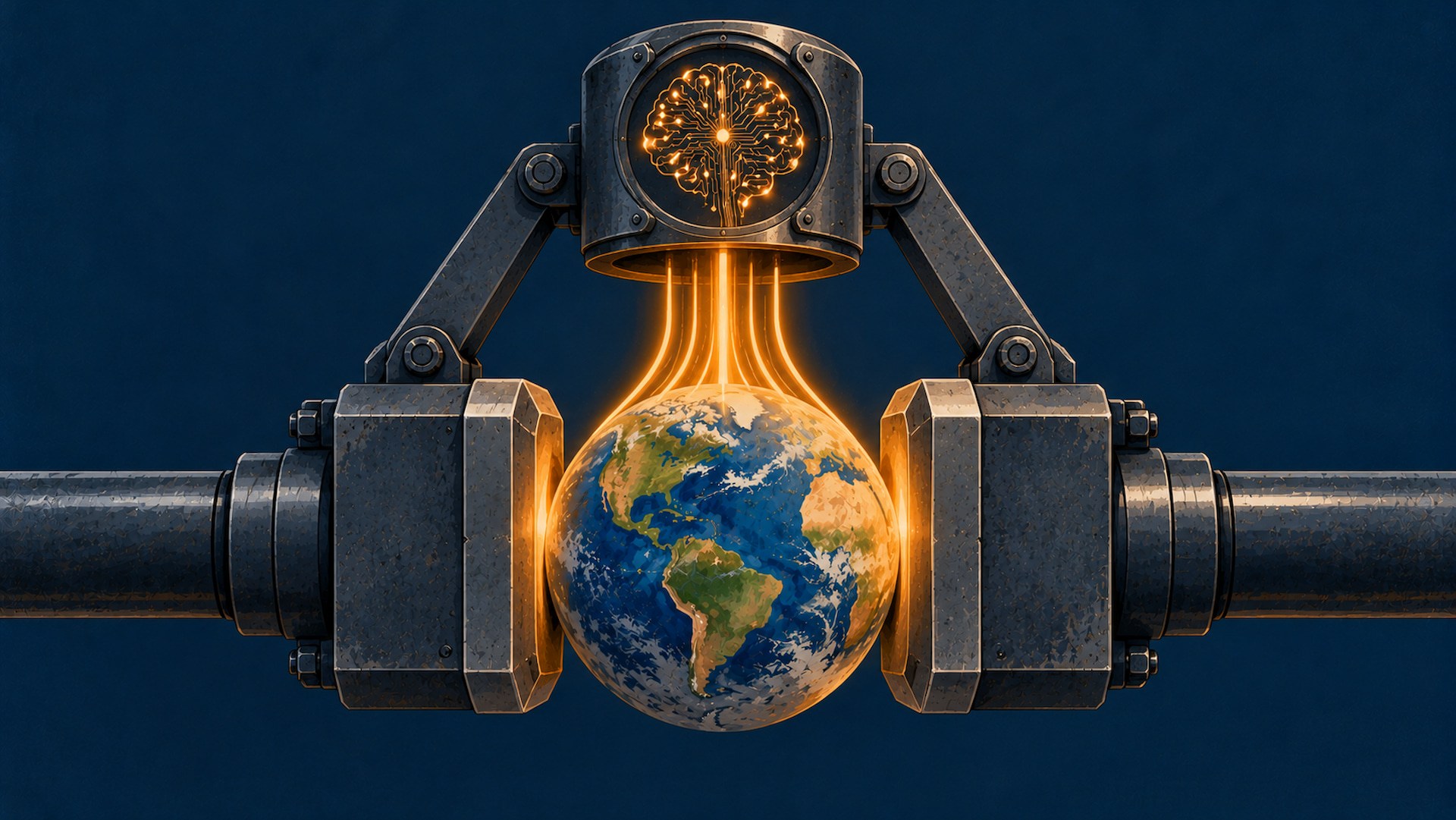
Data centres keep drawing more electricity, and the usual answer is more power plants. A journey from a single question on a screen down to the physics of neutrinos asks whether the question itself needs rethinking.
Ground Floor: The Screen
A question goes in. Two seconds later an answer comes back, fluent and composed, apparently from nowhere. Nothing about the exchange feels heavy.
The vocabulary of the digital age was built to keep it that way. The cloud, streaming and wireless each take one more cable out of the mind. For decades it was easy to believe that intelligence, once turned into software, had left the physical world behind.
The weight was always there. It sits in buildings at the edge of cities, in substations, in cooling loops and in rivers that someone else also needs. Following a single question down to where that weight lands is the quickest way to see what this technology asks of the planet.
B1: The Ground
The International Energy Agency puts the growth in electricity consumption by data centres at roughly 17 percent for 2025 alone. In the United States they accounted for nearly half of the year’s growth in demand, and the agency expects their expansion to drive about half of the rise in American demand through 2030.
Lawrence Berkeley National Laboratory has estimated that data centres could take around 11.8 percent of US electricity by 2030. Its scenarios run from 9.5 to 15.3 percent, and the width of that range matters. It shows that the number depends on decisions nobody has made yet, about chips, workloads and how many facilities get built.
Japan shows what the arithmetic looks like on the ground. A consortium of JERA, Dell Technologies and RHAELM is planning AI infrastructure that could reach $140 billion in investment. Its first project, in Chiba near Tokyo, would cost around $15 billion and provide about 400 megawatts of capacity. The software is the glamorous part, but the plan stands or falls on whether 400 megawatts can be delivered reliably, hour after hour.
The conventional answer to a demand curve like this is familiar: more gas turbines, more reactors, more renewables, more transmission lines. All of them are real and all will be needed. Each is also a construction project that has to be finished before the load it serves can run, and the load is arriving faster than construction usually moves.
B2: The Water
Heat is electricity’s shadow. Every watt a processor consumes leaves as warmth, and removing it can mean drawing heavily on local water. The footprint varies with cooling design, climate, workload and the way the electricity itself is generated, so some facilities are gentle neighbours and others aren’t.
In Cape Town, a city that still carries the memory of its 2017 to 2018 “Day Zero” water crisis, plans for two large Equinix data centres drew objections over electricity, water use and environmental disclosure. The municipality approved both in July 2026. Months later, in October, Amazon announced a $1 billion, five-year programme for US communities that host its facilities.
Both episodes show that energy for AI has a social dimension that engineering alone can’t settle. A data centre needs permission as well as power: from a city council, from farmers downstream, from households watching their bills. A source of electricity that asks less of its surroundings changes that negotiation, and the way a power source is sited has become part of how it is judged.
B3: The Bunker
The next floor down is stranger. After regional attacks, the United Arab Emirates, which is pursuing AI infrastructure at the multi-gigawatt scale, has reportedly reconsidered the physical design of its major facilities. The options under study include underground halls, dispersed sites and hardened layouts of the kind usually reserved for military installations and critical energy assets.
The logic extends beyond one country. Large data centres create dependencies in the way ports and energy terminals do: when one fails, the disruption travels through every business that rented its capacity.
India offers the mirror image. The country generates about a fifth of the world’s data and holds under 6 percent of global data-centre capacity. Installed capacity has grown from about 375 megawatts in 2020 to around 1,500 by 2025, a fourfold rise in five years. The IndiaAI Mission had opened access to more than 45,000 GPUs by June 2026. Delhi’s phrase for all of this is “technological sovereignty,” and the phrase is accurate. A country that rents its compute depends on foreign chips and, in the end, on foreign power.
Every national strategy for AI is therefore also a strategy for electricity. Semiconductor powers can run short of energy, energy-rich states can lack the industry, and water-rich regions can lack the capital. These mismatches will shape alliances and rivalries for decades.
Notice what happens as the planning matures. The most advanced computers on Earth are being drawn downward, into rock, away from the sky and away from view. Physics took that route long ago, for a reason that has nothing to do with defence.
B4: The Mine
In 1930 Wolfgang Pauli proposed a particle that nobody could see, to rescue a conservation law. He offered it with visible embarrassment, as a desperate remedy. The particle was electrically neutral and almost entirely indifferent to matter. A textbook image from the following decade has a neutrino crossing light-years of lead without noticing it.
Experimental confirmation took until 1956, when Clyde Cowan and Frederick Reines caught a few of them beside a nuclear reactor. The difficulty was never rarity. About 65 billion solar neutrinos pass through every square centimetre of the Earth’s surface each second, which means through a thumbnail every moment of every day. The difficulty is that almost none of them interact.
That is why neutrino detectors sit in mines. Rock stops nearly everything else, including the cosmic-ray background that would drown the faint signal, and lets the neutrinos through. The Super-Kamiokande detector in Japan and the Sudbury Neutrino Observatory in Canada both occupy deep underground chambers. Their data established in the late 1990s and early 2000s that neutrinos change type as they travel, which is only possible if they have mass. The 2015 Nobel Prize in Physics went to Takaaki Kajita and Arthur McDonald for that result.
Mass carries momentum, and momentum can in principle be handed on. A second thread of research made the point concrete. In 1974 Daniel Freedman predicted coherent elastic neutrino-nucleus scattering (CEνNS): at low energies a neutrino can strike an entire nucleus at once rather than a single particle inside it. The interaction rate then scales with the square of the neutron number. In 2017 the COHERENT collaboration, working at Oak Ridge National Laboratory, observed it.
Two things follow from this history, and both matter for what comes next. Neutrino mass, oscillation and coherent scattering are established physics, confirmed by independent experiments and honoured with a Nobel Prize. Every one of those experiments was also built to count events, and detectors are enormous because the events are rare. Nobody in that tradition set out to build a power supply. Whether coherent scattering, lattice physics and engineered materials can be organised into one is a question of materials engineering, and it is the question that a handful of groups have decided to ask.
B5: The Material
Neutrino® Energy Group, a research and engineering effort founded by the mathematician Holger Thorsten Schubart, builds its work on that question. Its field is called neutrinovoltaics.
The group’s first decision is a departure from the detector tradition. A detector isolates one channel and tries to hear it above the noise. The group treats the environment as a multi-channel input: neutrinos, cosmic muons (which reach the ground at well-measured rates), thermal fluctuations and electromagnetic background fields, all acting on the same material at once. In its view the noise is part of the supply.
The material is a stack of alternating layers of graphene and doped silicon, arranged at atomic thickness. The proposed mechanism runs as follows. A passing particle transfers a tiny amount of momentum to an atomic nucleus. The nucleus recoils slightly, and the recoil sets up phonons, quantised vibrations in the crystal lattice. Across billions of simultaneous events, those vibrations are converted into electrical current by three established couplings: piezoelectric, flexoelectric and phonon-electron coupling in the electronic structure of graphene. Asymmetric junctions then rectify the random motion into a net direction.
Layer thickness, doping concentration and stacking order set the resonant frequencies, and the structure behaves like a mechanical antenna. Resonance concentrates energy that has already been absorbed and raises conversion efficiency, but it creates nothing. The group is explicit that resonance adds no energy beyond what the environment provides.
B6: The Ceiling
Most energy technologies were built first and described later. Steam drove factories decades before thermodynamics existed. Schubart reversed the order, and the mathematics came before the hardware. The result is the Schubart Master Formula:

P(t) is the time-dependent usable electrical output power, in watts — it is power, not energy. η is a dimensionless efficiency between 0 and 1. Φ_eff(r, t) is the effective ambient input at position r and time t, and σ_eff(E) is the material’s effective coupling at energy E. The integral runs over the active material volume V.
The formula works the way the Carnot limit works for heat engines. Carnot’s result doesn’t predict what a particular engine delivers. It sets the ceiling that no engine can exceed and shows which quantities control the result. The Schubart Master Formula does the same job for this class of device: output can never exceed what the environment supplies, and the framework is built around that line.
The structure of the expression also defines the engineering agenda. Output rises with the coupling of the material, the efficiency of conversion and the active volume, and all three are properties of design. The work is to find the layer thicknesses, doping levels and stacking sequences that push η and σ_eff upward.
That search is where artificial intelligence enters. The design space is enormous, the interactions are quantum-mechanical, and testing each combination in a laboratory would take longer than anyone has. Research teams in several countries use machine learning to simulate atomic-scale behaviour and to rank configurations before prototypes are built. The simulations run on the same kind of power-hungry hardware this article began with.
The loop is easy to state. Computing helps design a material, and the material may one day help power computing. The loop is also not yet closed, and the reason is physical. Manufacturing and measurement can’t be simulated into existence, and each prototype has to be built.
The group’s own model-level analysis, a set of Monte Carlo simulations and multi-parameter evaluations, reports statistical consistency of 5.9 to 6.0 sigma. That number describes the internal consistency of the physical model under its stated assumptions. It doesn’t describe the commercial output of any product, and the group doesn’t claim that it does.
B7: The Cube
The group’s flagship unit is the Neutrino Power Cube, a cabinet of 800 × 400 × 600 mm weighing about 50 kilograms. It is specified at 5 to 6 kilowatts of continuous net output. It is solid-state, with no fuel, no exhaust and no moving parts. A companion unit, the Neutrino Life Cube, builds a 1 to 1.5 kilowatt generation unit into a housing together with climate control and an air-to-water purifier that delivers up to 25 litres of water a day, depending on climatic conditions.
Set the cube beside Chiba and the arithmetic becomes interesting. A data centre of 400 megawatts is 400,000 kilowatts. Divided by 5 kilowatts, that is 80,000 cubes, or about 66,700 at 6 kilowatts. At 50 kilograms each, 80,000 units would weigh 4,000 tonnes. At 0.192 cubic metres each, they would occupy roughly 15,400 cubic metres before any spacing, cabling or cooling, a block about 25 metres on every side. The same multiplication gives 200,000 cubes for a gigawatt, the electrical output of one large reactor.
The comparison shows why architecture matters more than the nameplate. A reactor is a single point, and its failure takes a gigawatt with it. A field of cubes is a population of independent units, and losing one costs one 5-kilowatt slice. That profile resembles what planners in the Gulf are reportedly exploring: dispersed sites, underground halls and no dependence on a single line or a single plant. The design is also indifferent to sunlight, wind and fuel logistics, which is why the group describes it as location-independent.
The ledger needs one more line, and it belongs in the same column as the specifications. The cubes are prototypes, and manufacturing scale is small. A gigawatt at the Chiba scale is a calculation today, not a shipping schedule.
What turns a calculation into a supply is the standard route for any conversion device. Long-duration output has to be measured with complete input accounting, the environmental channels have to be separable in the data, and production has to be repeatable from one unit to the next. The framework supplies the questions, and the answers come from laboratories and factory floors.
Ground Floor, Again
The rise back to the surface offers three answers to the problem posed at the top. The first is to build more of what already exists, which is happening and will have to continue. The second is to build closer to the load, with smaller units and dispersed sites. The third is to ask whether the idea of a power source has stayed too narrow.
Every conventional answer assumes that energy is a thing delivered from somewhere to somewhere, so the map of artificial intelligence follows the map of power: Chiba for its grid, Cape Town for its permits, the Gulf for its bunkers. Neutrino research proposes the opposite assumption. In that reading the medium itself, the matter and radiation already present in every room, could be the supply, with the ceiling set by arithmetic rather than geography. Whether engineering can turn the proposal into watts at scale is what the next years of measurement will show.
The two-second answer on the screen carries a weight that is still being counted. The question of where that weight should come from is older than it looks, and it is only now being asked properly.

The Silent Tax Everyone Pays: What a Home's Idle Hours Actually Cost
A house is never actually off. It has a baseline hum, a floor of demand that persists through the quietest hours of every day — and that floor turns out to be a much larger part of the story than the number at the bottom of a monthly bill suggests.

The Grid Is Becoming the Scarce Resource
Six stories from four continents in a single week describe the same wall from six directions. The energy question of the 21st century is no longer only how much electricity we can generate — it is how much infrastructure we must build to move it.
AI Could Save the Planet, If It Can Get the Power to Do It
A major LSE study says AI could cut emissions by billions of tonnes annually — but only if it gets enough clean electricity. Where does that power come from?