
Energy 9 min read
Cosmic Neutrinos: A Novel Universe Map
The neutrinos are important for studying fundamental physics since physicists now know the origin of at least some of these high-energy particles.
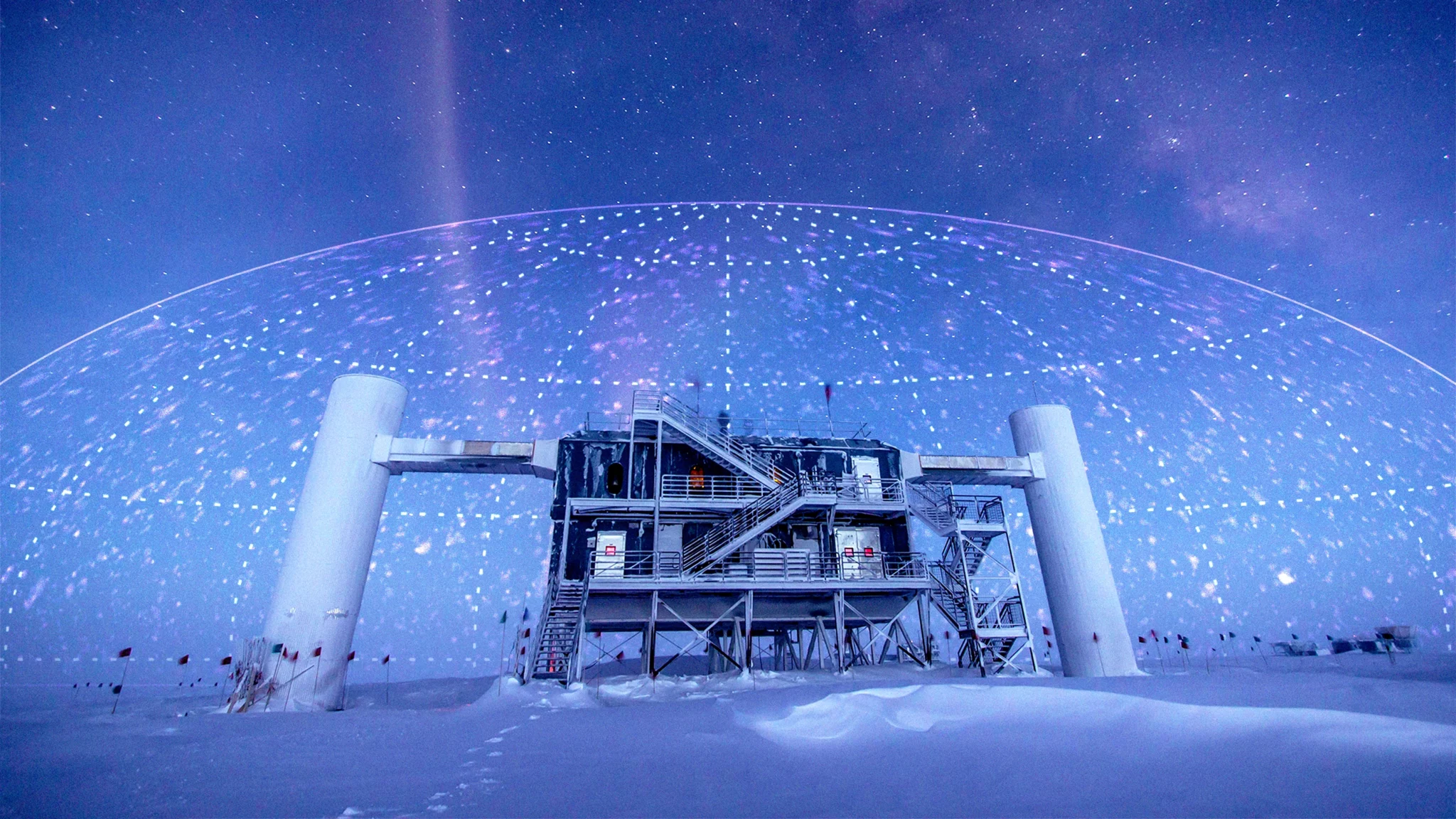
Cosmic Neutrinos: A New Map of the Universe
The neutrinos are important for studying fundamental physics since physicists now know the origin of at least some of these high-energy particles.
The majority of the 100 trillion neutrinos that enter your body every second originate from the sun or Earth’s atmosphere. However, a small portion of the particles—those traveling considerably faster than the others—came from strong sources further away. Astrophysicists have been searching for the source of these “cosmic” neutrinos for decades. At last, the IceCube Neutrino Observatory has gathered enough of them to identify distinct patterns in their origins.
The group presented the first neutrino map of the Milky Way in an article that was published today in Science (opens a new tab). (Usually, photons—particles of light—are used to map out our galaxy.) Strangely, no distinct sources are visible on the new map, which depicts a thick haze of cosmic neutrinos coming from all throughout the Milky Way. Francis Halzen, the leader of IceCube, stated, “It’s a mystery” (opens a new tab).
The findings come after an IceCube study published in Science last fall (opens a new tab), which was the first to link cosmic neutrinos to a single source. It revealed that a significant portion of the cosmic neutrinos the observatory has found thus far originate from the core of NGC 1068, a “active” galaxy. Cosmic neutrinos are created when matter spirals into a central supermassive black hole in the blazing core of the galaxy.
Kate Scholberg, a Duke University neutrino physicist who was not involved in the study, stated, “It’s really gratifying” (opens a new tab). In fact, they have discovered a galaxy. The entire neutrino astronomy community has been working toward this kind of goal for ages.
Finding the sources of cosmic neutrinos makes it possible to use the particles as a new fundamental physics probe. Researchers have demonstrated that neutrinos may be used to evaluate quantum theories of gravity and uncover gaps in the dominant Standard Model of particle physics.
However, figuring out where at least some cosmic neutrinos come from is just the beginning. The mechanism by which the activity surrounding some supermassive black holes produces these particles is poorly understood, and the data thus far suggests a variety of processes or conditions.
Long-Seeked Source
Despite their abundance, neutrinos often travel through Earth without leaving any trace, necessitating the construction of an incredibly large detector in order to identify patterns in the directions from which they originate. Built 12 years ago, IceCube is made up of chains of detectors that are kilometers long and are dug deep into Antarctic ice. Every year, IceCube finds about twelve cosmic neutrinos that are so energetic that they can be distinguished from a cloud of atmospheric and solar neutrinos. Additional possible cosmic neutrinos can be extracted from the remaining data using more complex methods.
Astrophysicists know that such energetic neutrinos could only arise when fast-moving atomic nuclei, known as cosmic rays, collide with material somewhere in space. And very few places in the universe have magnetic fields strong enough to whip cosmic rays up to sufficient energies. Gamma-ray bursts, ultrabright flashes of light that occur when some stars go supernova or when neutron stars spiral into each other, were long thought one of the most plausible options. The only real alternative was active galactic nuclei, or AGNs —galaxies whose central supermassive black holes spew out particles and radiation as matter falls in.
The gamma-ray-burst theory lost ground in 2012, when astrophysicists realized that if these bright bursts were responsible, we would expect to see many more cosmic neutrinos(opens a new tab) than we do. Still, the dispute was far from settled.
Then, in 2016, IceCube began sending out alerts every time they detected a cosmic neutrino, prompting other astronomers to train telescopes in the direction it came from. The following September, they tentatively matched up a cosmic neutrino with an active galaxy called TXS 0506+056, or TXS for short, that was emitting flares of X-rays and gamma rays at the same time. “That certainly sparked a lot of interest,” said Marcos Santander(opens a new tab), an IceCube collaborator at the University of Alabama.
More and more cosmic neutrinos were collected, and another patch of sky began to stand out against the background of atmospheric neutrinos. In the middle of this patch is the nearby active galaxy NGC 1068. IceCube’s recent analysis shows that this correlation almost certainly equals causation. As part of the analysis, IceCube scientists recalibrated their telescope and used artificial intelligence to better understand its sensitivity to different patches of sky. They found that there’s less than a 1-in-100,000 chance that the abundance of neutrinos coming from the direction of NGC 1068 is a random fluctuation.https://www.strahlungsfrei.at/elektrosmog-in-den-medien.html
Statistical certainty that TXS is a cosmic neutrino source isn’t far behind, and in September, IceCube recorded a neutrino probably from the vicinity of TXS that hasn’t been analyzed yet.
“We were partially blind; it’s like we’ve turned the focus on,” said Halzen. “The race was between gamma-ray bursts and active galaxies. That race has been decided.”
The Physical Mechanism
These two AGNs appear to be the brightest neutrino sources in the sky, yet, puzzlingly, they’re very different. TXS is a type of AGN known as a blazar: It shoots a jet of high-energy radiation directly toward Earth. Yet we see no such jet pointing our way from NGC 1068. This suggests that different mechanisms in the heart of active galaxies could give rise to cosmic neutrinos. “The sources seem to be more diverse,” said Julia Tjus(opens a new tab), a theoretical astrophysicist at Ruhr University Bochum in Germany and a member of IceCube.
Halzen suspects there is some material surrounding the active core in NGC 1068 that blocks the emission of gamma rays as neutrinos are produced. But the precise mechanism is anyone’s guess. “We know very little about the cores of active galaxies because they are too complicated,” he said.
The cosmic neutrinos originating in the Milky Way muddle things further. There are no obvious sources of such high-energy particles in our galaxy — in particular, no active galactic nucleus. Our galaxy’s core hasn’t been bustling for millions of years.
Halzen speculates that these neutrinos come from cosmic rays produced in an earlier, active phase of our galaxy. “We always forget that we are looking at one moment in time,” he said. “The accelerators that made these cosmic rays may have made them millions of years ago.”
What stands out in the new image of the sky is the intense brightness of sources like NGC 1068 and TXS. The Milky Way, filled with nearby stars and hot gas, outshines all other galaxies when astronomers look with photons. But when it’s viewed in neutrinos, “the amazing thing is we can barely see our galaxy,” said Halzen. “The sky is dominated by extragalactic sources.”
Setting the Milky Way mystery aside, astrophysicists want to use the farther, brighter sources to study dark matter, quantum gravity and new theories of neutrino behavior.
Probing Fundamental Physics
Neutrinos offer rare clues that a more complete theory of particles must supersede the 50-year-old set of equations known as the Standard Model. This model describes elementary particles and forces with near-perfect precision, but it errs when it comes to neutrinos: It predicts that the neutral particles are massless, but they aren’t — not quite.
Physicists discovered in 1998 that neutrinos can shape-shift between their three different types; an electron neutrino emitted by the sun can turn into a muon neutrino by the time it reaches Earth, for example. And in order to shape-shift, neutrinos must have mass — the oscillations only make sense if each neutrino species is a quantum mixture of three different (all very tiny) masses.
Dozens of experiments have allowed particle physicists to gradually build up a picture of the oscillation patterns of various neutrinos — solar, atmospheric, laboratory-made. But cosmic neutrinos originating from AGNs offer a look at the particles’ oscillatory behavior across vastly bigger distances and energies. This makes them “a very sensitive probe to physics that is beyond the Standard Model,” said Carlos Argüelles*–*Delgado(opens a new tab), a neutrino physicist at Harvard University who is also part of the sprawling IceCube collaboration.
Cosmic neutrino sources are so far away that the neutrino oscillations should get blurred out — wherever astrophysicists look, they expect to see a constant fraction of each of the three neutrino types. Any fluctuation in these fractions would indicate that neutrino oscillation models need rethinking.
Another possibility is that cosmic neutrinos interact with dark matter as they travel, as predicted by many dark-sector models. These models propose that the universe’s invisible matter consists of multiple types of nonluminous particles. Interactions with these dark matter particles would scatter neutrinos with specific energies and create a gap(opens a new tab) in the spectrum of cosmic neutrinos that we see.
Or the quantum structure of space-time itself can drag on the neutrinos, slowing them down. A group based in Italy recently argued in Nature Astronomy(opens a new tab) that IceCube data shows hints of this happening, but other physicists have been skeptical(opens a new tab) of these claims.
Effects such as these would be minute, but intergalactic distances could magnify them to detectable levels. “That’s definitely something that’s worth exploring,” said Scholberg.
Already, Argüelles*–*Delgado and collaborators have used the diffuse background of cosmic neutrinos — rather than specific sources like NGC 1068 — to look for evidence of the quantum structure of space-time. As they reported in Nature Physics(opens a new tab) in October, they didn’t find anything, but their search was hampered by the difficulty of distinguishing the third variety of neutrino — tau — from an electron neutrino in the IceCube detector. What’s needed is “better particle identification,” said co-author Teppei Katori(opens a new tab) of King’s College London. Research is underway to disentangle the two types(opens a new tab).
Katori says knowing specific locations and mechanisms of cosmic neutrino sources would offer a “big jump” in the sensitivity of these searches for new physics. The exact fraction of each neutrino type depends on the source model, and the most popular models, by chance, predict that equal numbers of the three neutrino species will arrive on Earth. But cosmic neutrinos are still so poorly understood that any observed imbalance in the fractions of the three types could be misinterpreted. The result could be a consequence of quantum gravity, dark matter or a broken neutrino oscillation model — or just the still-blurry physics of cosmic neutrino production. (However, some ratios would be a “smoking gun” signature of new physics, said Argüelles*–*Delgado.)
Ultimately, we need to detect many more cosmic neutrinos, Katori said. And it looks as though we will. IceCube is being upgraded and expanded to 10 cubic kilometers over the next few years, and in October, a neutrino detector under Lake Baikal in Siberia posted its first observation(opens a new tab) of cosmic neutrinos from TXS.
And deep in the Mediterranean, dozens of strings of neutrino detectors collectively called KM3NeT(opens a new tab) are being fastened on the seafloor by a robot submersible to offer a complementary view of the cosmic-neutrino sky. “The pressures are enormous; the sea is very unforgiving,” said Paschal Coyle, a director of research at the Marseille Particle Physics Center and the experiment’s spokesperson. But “we need more telescopes scrutinizing the sky and more shared observations, which is coming now.”

The Silent Tax Everyone Pays: What a Home's Idle Hours Actually Cost
A house is never actually off. It has a baseline hum, a floor of demand that persists through the quietest hours of every day — and that floor turns out to be a much larger part of the story than the number at the bottom of a monthly bill suggests.

The Grid Is Becoming the Scarce Resource
Six stories from four continents in a single week describe the same wall from six directions. The energy question of the 21st century is no longer only how much electricity we can generate — it is how much infrastructure we must build to move it.
When a Machine Has a Seat at the Table: A Conversation with Holger-Thorsten Schubart
What changes when AI moves from background infrastructure into an explicitly named position inside a scientific and industrial organization? Ten pointed questions, unabridged answers.