
Climate Change 2 min read
"Climate Change Cartographies"
Yale Environmental Humanities was launched in 2018 as a platform to highlight and support the emerging interdisciplinary conversation, across departments and schools, about environmental problems and human connections to the natural world.
Today, environmental themes are deeply intertwined with the humanities across a broad range of courses at Yale — including the one featured here. Read an overview and explore other course features.
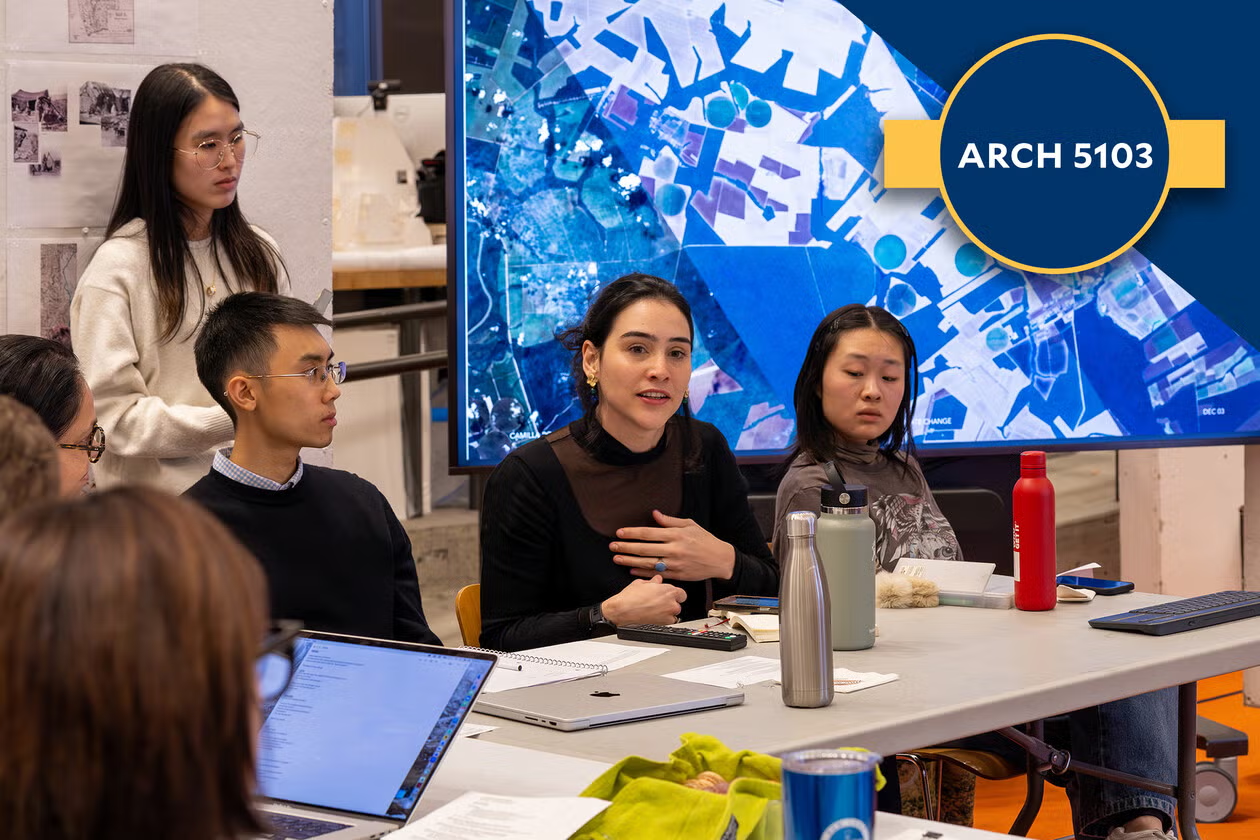
For her final presentation in this graduate seminar in architecture, Nico Cao created a cartography, or visual representation, of the damage caused by human-created microparticles, like microplastics. The challenge for her was mapping something that is “planetary and global in scale of impact despite being invisible to the naked eye” and can cause harmful contamination that “is permanent and irreversible,” she explained to her classmates gathered in Rudolph Hall during the last class of the fall semester.
Among the ways she devised to model their prevalence was a digital collage of images showing the chain of contamination caused in Michigan, in 2022, by the illegal dumping of wastewater containing hexavalent chromium.
Another student, Camilla Paiva, from Rio de Janeiro, Brazil, explained that she looked for ways to capture the scope of deforestation in the Amazon region of her native country. She created a collage with swatches of paper with burned edges, a nod to the burning of forestlands, and colors and shapes representing illegal logging, clear cutting, and other harmful practices. To give a sense of how the loss of rainforests changes the texture of life there, she mapped the diminishing sounds of wildlife as lands are cleared.
This course grew out of instructor Joyce Hsiang’s own work as a researcher and architect examining the impact of urbanization at the planetary scale.
“The scientific community has all this information and data about climate change and the environment, but how can we find more meaningful and inventive ways to make sense of it and communicate to broader audiences?” said Hsiang, an assistant professor of architecture. “You can’t even begin to address or reimagine it without being able to study these problems spatially.”
The seminar included readings from voices across disciplines that look at the representation of climate change, either in communications to the public or as a philosophical idea. Instead of responding to those readings through writing or discussion, students were required to respond with drawings, maps, or collages bolstered by their own research.
“The seminar is for student to ask themselves, what role do architects have in addressing the challenges of climate change?” Hsiang said. “Is it only within the design of specific buildings or master plans, or are there other ways in which we can advocate and bring issues to bear?”
Neutrino® Energy Group Establishes Neutrino Engineering District to Move Scientific Consistency Toward Industrial Infrastructure
New global initiative brings physics, materials science, engineering, artificial intelligence, industrialisation and professional training into a distributed architecture built around one objective: turning validated physical effects into reproducible systems.

While the World Debates Solar and Wind, a Different Race Is Underway
The physics of neutrino science has reached a threshold. The question now is who acts on it first.

The Energy Problem AI Cannot Solve for Itself
Efficiency is not the answer. It never was. The question was always about continuity.