
News 6 min read
The Energy Problem AI Cannot Solve for Itself

Efficiency is not the answer. It never was. The question was always about continuity.
Microsoft has built its AI data center ambitions on a 2030 commitment to match 100 percent of its hourly electricity use with clean power on the same grid. According to recent reporting, the company is now weighing whether to delay or abandon that hourly matching goal entirely, as its rapid buildout of AI infrastructure puts pressure on its ability to meet the target.
This is not a story about one company reconsidering one pledge. It is a signal about the nature of the problem. When the most well-resourced technology company on Earth finds its clean energy commitments becoming an impediment to its own AI ambitions, the gap between what is being promised and what is physically achievable is no longer a matter of effort or intention. It is a matter of architecture.
A piece published in POWER magazine, by Dr. Anastasia Behr and Dr. Young Lee, frames the problem with precision. The article makes three arguments that deserve to be taken seriously by anyone thinking about what AI infrastructure actually requires from the energy system.
First: inference workloads, not training runs, are now the dominant and growing energy cost of AI. Every question answered, every image generated, every recommendation served draws electricity continuously, at scale, across every industry simultaneously. The training run is a one-time event. The inference is permanent and expanding.
Second: the efficiency tools that exist are real and insufficient simultaneously. Model quantisation, smarter batching, workload scheduling, power usage effectiveness improvements: these produce genuine gains that are absorbed by growth before they appear in emissions figures. The optimisation is happening. The consumption is growing faster.
Third: energy is no longer just an infrastructure cost for AI operators. It is a design constraint. Site selection, electricity sourcing, and utility relationships now carry strategic weight they never had before. Nevada’s largest utility has said it will need three times the electricity required to power Las Vegas just to handle proposed data centers, and it probably cannot do that without fossil fuels.
Behr and Lee are right about all of this. But there is one step further the analysis needs to go, and it changes the conclusion entirely.
The Wrong Frame for the Right Problem
The energy problem AI faces is not primarily a volume problem. It is a continuity problem.
AI infrastructure requires uninterrupted power delivery. Not peaks. Not averages. Not hourly matching across an annual ledger. Continuous, stable, guaranteed power, 24 hours a day, 365 days a year, regardless of weather, season, grid stress, or geopolitical disruption. A data center that goes dark for four hours loses more than electricity. It loses the inference workloads of millions of users, the training checkpoints of ongoing model runs, and the trust of enterprise customers whose operations depend on its availability.
Solar provides power when the sun shines. Wind provides power when the wind blows. Both are genuinely valuable, genuinely deployable, and genuinely insufficient for this specific requirement. The problem is not their carbon footprint. The problem is their physics. Intermittency cannot be engineered away through procurement or scheduling. It is a property of the source.
Google and Microsoft have both set 2030 goals to offset their energy consumption hour by hour with carbon-free power. The difficulty of achieving this is now forcing internal debates at the highest levels about whether the commitment is feasible at the pace of AI expansion.
This is the honest signal. When the goal is hourly carbon-free matching and the infrastructure is growing faster than the clean power supply can follow, the solution being reached for is not a new energy architecture. It is a looser definition of the original commitment. That is the wrong direction.
“The problem is not a lack of energy,” Holger Thorsten Schubart, the mathematician and systems architect at the centre of the Neutrino® Energy Group‘s work, has observed, “but the way we think about it.” The thinking that produced solar and wind PPAs as the answer to data center energy needs was never wrong about the value of those sources. It was wrong about whether they match the requirement.
What Continuity Actually Requires
The question the Behr and Lee piece doesn’t ask is: what kind of energy architecture actually solves the continuity problem?
Not more solar. Not larger batteries. Not smarter scheduling. Those are generation and storage solutions to an intermittency problem. The actual solution requires a source that doesn’t have an intermittency problem in the first place.
Neutrinovoltaic technology is a solid-state energy conversion system that draws on persistent ambient environmental energy: thermal fluctuations, electromagnetic background fields, cosmic particle interactions, and microscopic vibrations. These inputs are not periodic. They are continuous, omnipresent, and do not vary with weather, season, latitude, or time of day. The graphene-silicon multilayer nanostructures at the core of the system convert these ambient excitations into directed electrical output through asymmetric rectification. The system is open, non-equilibrium, and continuously driven. It doesn’t store energy and release it. It converts energy that is always present.
The Neutrino Power Cube delivers 5 to 6 kilowatts of continuous net electrical output from a unit measuring 800 by 400 by 600 millimetres and weighing approximately 50 kilograms. No moving parts. No combustion. No fuel. No grid connection required. Its output does not fluctuate with weather or time of day because its energy sources do not fluctuate with weather or time of day.
The scalability arithmetic is straightforward. 200,000 Power Cubes produce approximately 1,000 megawatts of continuous output, comparable to a mid-sized nuclear power station, but distributed, modular, and deployable without the permits, fuel supply chains, or grid infrastructure that centralised generation requires. Each unit operates independently. There is no single point of failure in a distributed architecture of this kind.
There is one more dimension to acknowledge: the graphene-silicon nanostructures in these systems are optimised using AI to maximise coupling efficiency and adapt to local environmental conditions in real time. The technology that created the energy demand problem is part of the solution architecture. “Without power, AI remains a thought experiment,” Schubart has said. “With neutrinovoltaics, intelligence becomes unbounded.”
The Consequence the Industry Hasn’t Reached Yet
A data center powered by neutrinovoltaic units doesn’t need power purchase agreements. It doesn’t need utility relationships or hourly carbon matching commitments. It doesn’t need to schedule inference workloads around grid carbon intensity windows or maintain backup diesel generators for grid outages. It doesn’t need to choose its location based on proximity to renewable energy infrastructure or the negotiating position of a regional utility.
It needs the right material architecture, deployed at the right scale, starting at whatever scale demand currently requires and expanding modularly as that demand grows. No lead times measured in years. No permitting processes for new transmission infrastructure. No exposure to the geopolitical disruptions that make energy supply a strategic vulnerability.
Cumulative electricity costs attributable to data centers from 2026 to 2050 range from 886 billion to 978 billion dollars, representing 18 percent of total US wholesale electricity costs alone. That figure describes the scale of the dependency being built into AI infrastructure under the current energy paradigm. Every dollar of that figure assumes the same model: centralised generation, grid transmission, utility relationships, and the intermittency management that renewable sources require.
The same underlying architecture that could reframe data center energy economics could also power a clinic in a region where no grid has ever existed. The Neutrino Life Cube integrates a 1 to 1.5 kilowatt generation unit with climate control and an air-to-water purifier producing 12 to 25 litres of clean water per day. It is not designed for hyperscale computing. It is designed for the other end of the energy access problem. But the physics is identical. A source that doesn’t require infrastructure to exist works equally well where infrastructure is absent and where it has failed.
The POWER magazine piece is correct that energy has become a design constraint for AI. The conclusion that follows from that is not to optimise within the existing energy paradigm. It is to recognise that the paradigm is the constraint.
Ignoring this shift is not a neutral decision. It is a strategic choice with consequences.
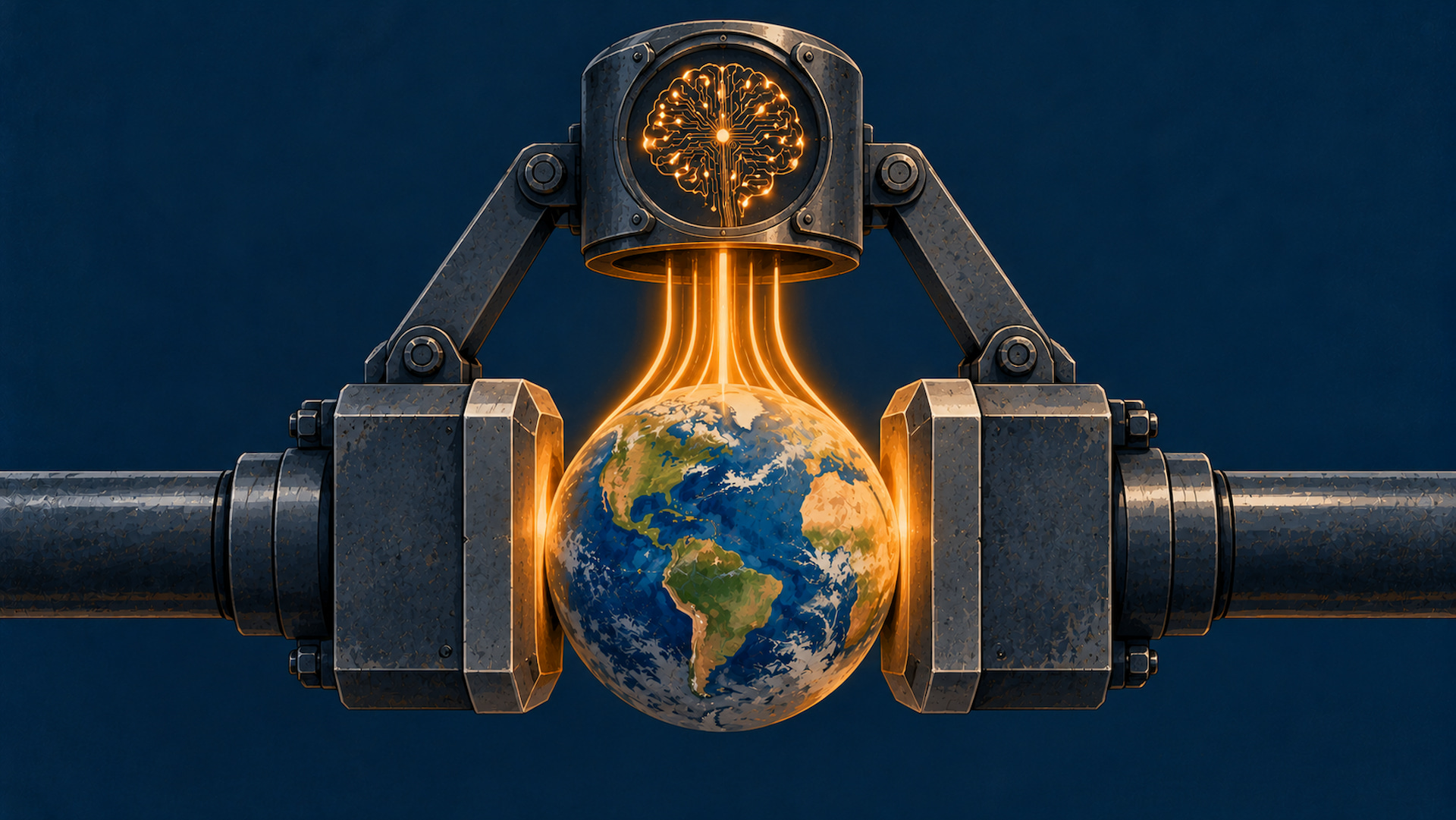
How Much Power Does AI Really Need, and Why Are We Still Squeezing the Earth to Find It
Data centres keep drawing more electricity, and the usual answer is more power plants. A journey from a single question on a screen down to the physics of neutrinos asks whether the question itself needs rethinking.
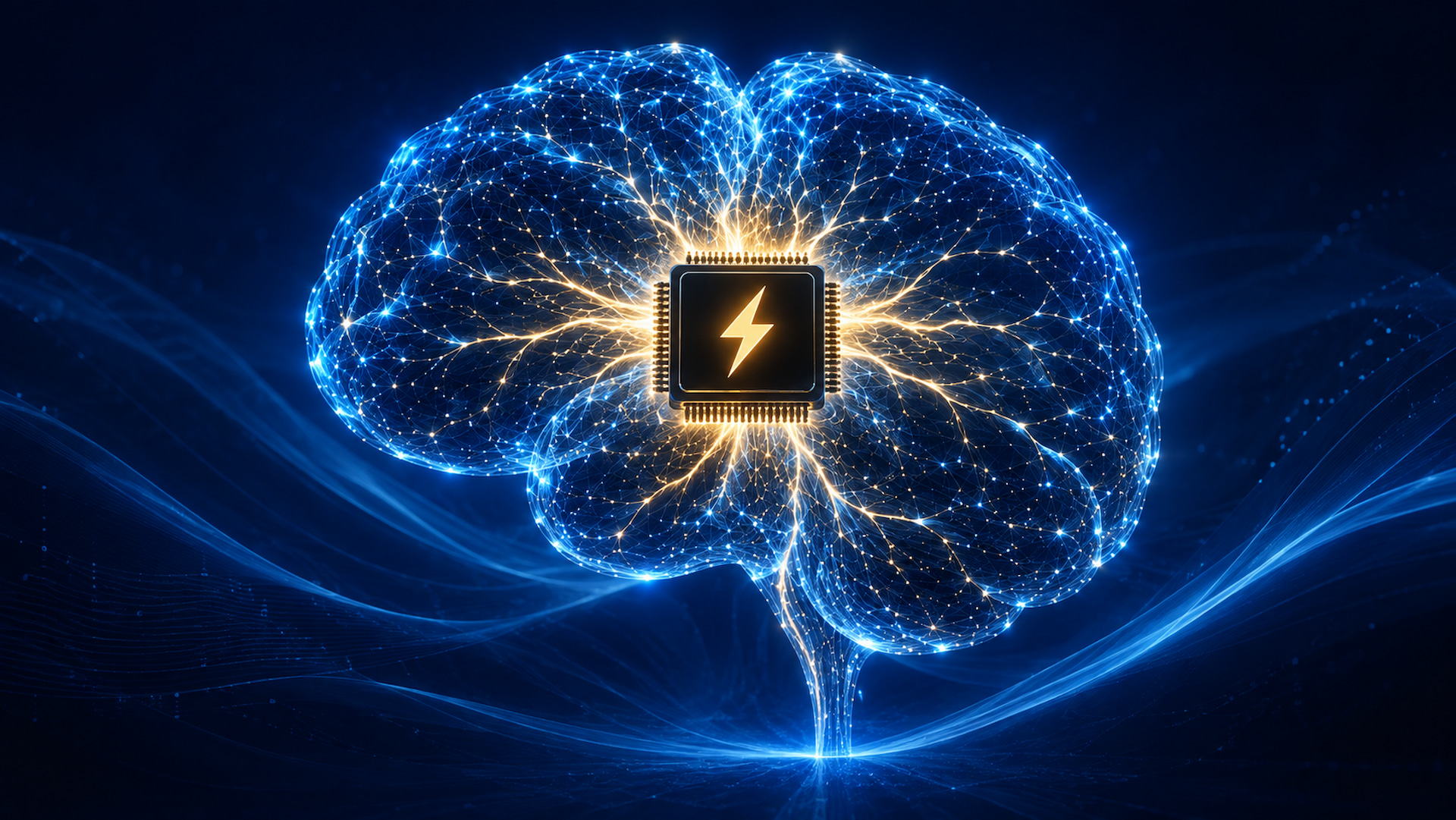
AI Could Save the Planet, If It Can Get the Power to Do It
A major LSE study says AI could cut emissions by billions of tonnes annually — but only if it gets enough clean electricity. Where does that power come from?
When a Machine Has a Seat at the Table: A Conversation with Holger-Thorsten Schubart
What changes when AI moves from background infrastructure into an explicitly named position inside a scientific and industrial organization? Ten pointed questions, unabridged answers.