
Energy 6 min read
Terafab and the Hidden Energy Story Behind the World's Biggest Chip Factory
A facility fifteen times the size of the Pentagon is being built in Texas. The real story isn't the size — it's what it reveals about where industrial power is headed.
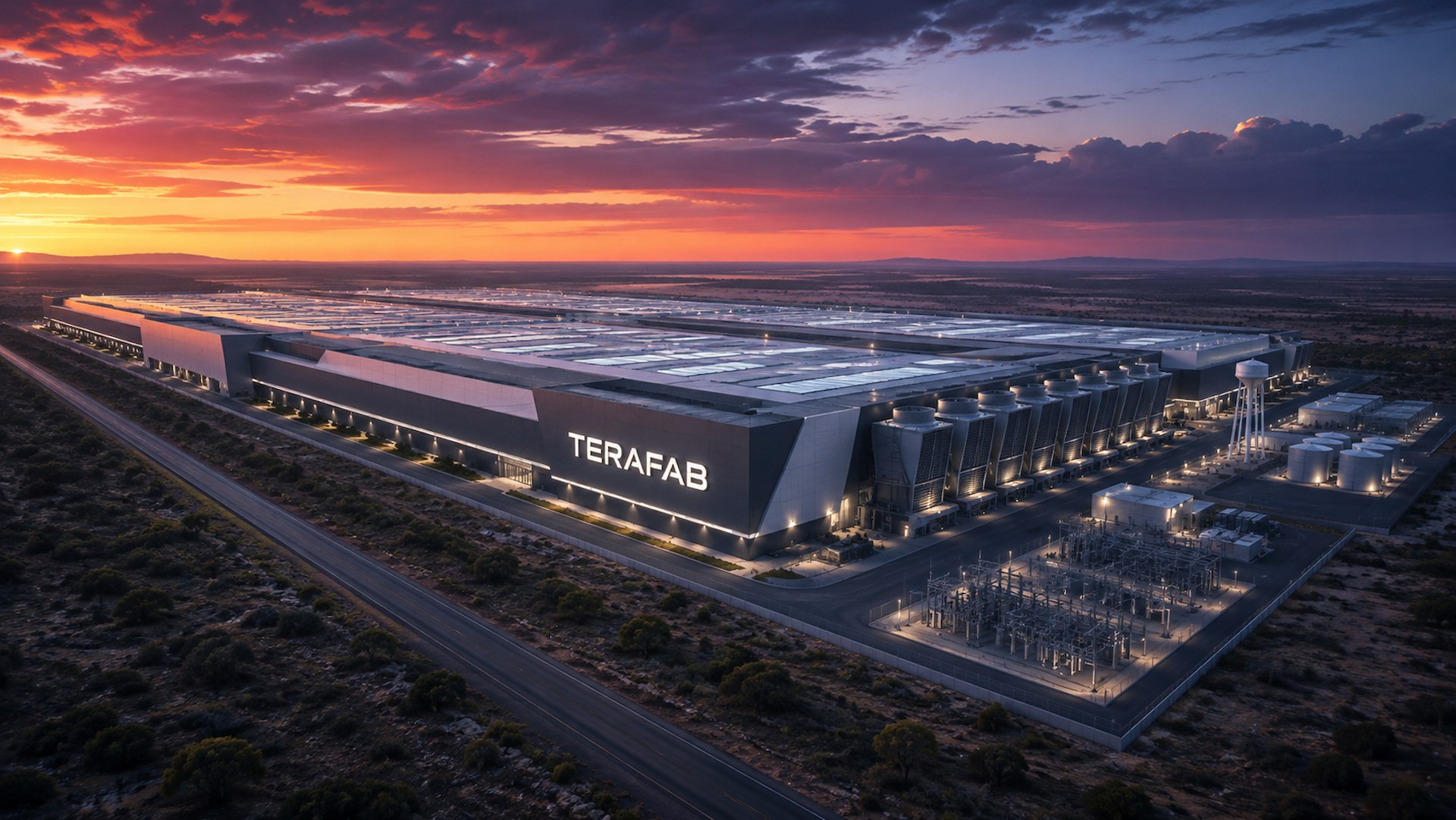
A Building Fifteen Pentagons Wide
In Grimes County, Texas, construction is beginning on a facility called Terafab, a semiconductor manufacturing complex jointly developed by Tesla and SpaceX, confirmed publicly only in the past few days with an initial announced investment of 16.8 billion US dollars. The project could grow substantially larger at full build-out, according to current plans. The planned facility spans approximately 100 million square feet, roughly 9.3 million square meters of building area.
For a sense of scale: the Pentagon, one of the largest office buildings in the world, covers approximately 6.5 million square feet. Terafab, at full scale, is planned to be roughly 15 times that footprint, rising out of rural Texas to manufacture chips for robots, autonomous vehicles, and AI computing infrastructure.
That’s an arresting number, and it’s the number most of the initial coverage has led with. It’s also, in a real sense, the least interesting part of this story.
What Terafab Is Actually For
The stated purpose behind Terafab isn’t the size record. Tesla and SpaceX together anticipate a long-term need for more than 1 terawatt of computing capacity, and the facility is designed to bring logic chips, memory, and advanced packaging together under a single roof, producing chips specifically for Optimus, Cybercab, and SpaceX’s planned computing infrastructure.
That terawatt figure deserves a careful pause, because it’s the kind of detail that’s easy to misread at a glance. The widely cited “1 terawatt” refers to the planned annual compute capacity of the chips the facility will produce, a measure of processing capability, not a confirmed 1-terawatt electricity demand for the facility itself. Those are two entirely different quantities, and conflating them would badly overstate the story. The facility’s actual continuous electrical power requirement has not been publicly disclosed.
The Real Story Buried in the Announcement
Here’s the detail worth sitting with instead. Current reporting indicates Terafab will not be primarily powered by large-scale solar. It will rely substantially on onsite natural gas power generation, paired with large battery storage systems, with its own natural gas power plants built alongside the factory itself. The specific electrical generation capacity of that onsite generation hasn’t been publicly stated.
That decision says something worth paying attention to, independent of what it’s ultimately built on. A company operating at this scale, building what may become the largest single building on Earth, has apparently concluded that reliable, controllable, always-available power is valuable enough to build from scratch, on site, rather than assuming the surrounding grid can simply carry the load. Energy supply itself has become a strategic bottleneck serious enough to warrant building a power plant alongside the factory, not after it, not as an afterthought once construction wraps. That’s the actual news here, and it’s worth taking seriously as a signal of where large-scale AI and chip infrastructure believes energy planning needs to sit from day one.
A Thought Experiment: What Would It Actually Take
That raises a genuinely interesting engineering question, and it’s worth walking through honestly, as exactly what it is: a hypothetical arithmetic exercise, not a claim about Terafab’s actual, undisclosed power needs.
The Neutrino Power Cube is specified at 5 to 6 kilowatts of continuous net output per unit. Apply that figure across a few illustrative demand levels, purely to get a feel for the scale involved. At 100 megawatts of continuous demand, roughly 16,700 to 20,000 Power Cubes would be needed. At 500 megawatts, roughly 83,300 to 100,000. At 1 gigawatt, roughly 166,700 to 200,000. At 1.2 gigawatts, roughly 200,000 to 240,000.
These numbers are exactly what they appear to be: published unit specifications applied to hypothetical demand scenarios, nothing more. They say nothing about Terafab’s real electrical needs, which remain undisclosed, and they aren’t a suggestion that any facility would actually be equipped with hundreds of thousands of individual standalone units sitting side by side across a factory floor.
Individual Units Aren’t the Real Picture
Which is worth stating directly: that’s not how a facility at this scale would actually be built out, even hypothetically. If the underlying technology were proven and manufactured at industrial scale, the logical architecture wouldn’t be a field of individual consumer-oriented units. It would be large, standardized generation blocks, shared power electronics, shared cooling, shared grid integration and redundancy engineered in from the start, the same way real infrastructure gets built, in modules designed for exactly that purpose.
Picture, purely as an engineering thought experiment and nothing more, a hypothetical 10 megawatt module concept. Under that framing, a 1 gigawatt facility would require roughly 100 such modules, not 200,000 individual units. This modular block concept isn’t an existing or announced Neutrino® Energy Group product. It’s a way of thinking about what industrial-scale deployment of this kind of generation would actually have to look like, if it existed at that scale.
Why This Kind of Facility Is a Genuinely Interesting Match
Set aside, for a moment, any claim about what the technology can deliver today, and consider why a facility like Terafab represents a particularly well-suited hypothetical application for continuous generation technology in the first place.
Its demand profile is enormous and continuous, running 24 hours a day, which is a fundamentally different load pattern than typical grid consumption, closer to a baseload requirement than a variable one. Generation located directly at the point of consumption, rather than transmitted from a distant plant, could reduce the transmission infrastructure and grid buildout otherwise required to serve a facility this size.
A modular architecture could in principle scale alongside a facility’s growth, from kilowatts to megawatts to larger scale, rather than requiring all capacity to be built upfront in one enormous commitment. The sheer physical scale of a building this size, 100 million square feet, offers extensive surface and structural area where generation could in principle be integrated directly into building and infrastructure surfaces rather than requiring separate, dedicated land. And because the generation itself would be continuous rather than intermittent, unlike solar or wind, it would reduce dependency on the massive battery buffering that intermittent sources require to bridge the gaps between when they generate and when a facility actually needs power.
Two Different Bets on the Same Problem
It’s worth framing this comparison plainly and fairly, because both approaches are responding to the same real strategic question, just from different directions. Musk’s approach treats energy and computing as one integrated system from the start, building generation capacity alongside the factory itself rather than solving the energy question afterward, currently through onsite natural gas paired with battery storage.
The Neutrino® Energy Group’s work represents a different bet on the same underlying problem: that the industrial world’s growing, always-on power demand might eventually be better served by continuous, distributed, weather-independent generation than by either grid dependency or combustion-based onsite generation. Two legitimate approaches to a question the entire AI and chip industry is now facing simultaneously. Neither has beaten the other. Both are, in their own way, evidence that the question itself has become unavoidable.
What to Actually Watch For
There’s a specific number that would turn this from a thought experiment into something concrete: the actual disclosed electrical generation capacity of Terafab’s onsite natural gas plants, once and if that figure becomes public. That’s the real benchmark any alternative generation approach would eventually need to measure itself against, not the terawatt of compute, not the square footage, but the actual continuous electrical load a facility like this turns out to require. Until that number exists, everything else is scale, ambition, and a genuinely interesting question about where industrial power is headed next.

The Silent Tax Everyone Pays: What a Home's Idle Hours Actually Cost
A house is never actually off. It has a baseline hum, a floor of demand that persists through the quietest hours of every day — and that floor turns out to be a much larger part of the story than the number at the bottom of a monthly bill suggests.

The Grid Is Becoming the Scarce Resource
Six stories from four continents in a single week describe the same wall from six directions. The energy question of the 21st century is no longer only how much electricity we can generate — it is how much infrastructure we must build to move it.

AI Could Save the Planet, If It Can Get the Power to Do It
A major LSE study says AI could cut emissions by billions of tonnes annually — but only if it gets enough clean electricity. Where does that power come from?