
Science 3 min read
A Tiny Adjustment in a Lab Changed What AI Hardware Might Cost to Run

Three years of failed experiments. Then, in late November, the results changed.
Babak Bakhit, a researcher at the University of Cambridge’s Department of Materials Science and Metallurgy, had spent the better part of three years trying to build a memristor that actually worked at scale. Most attempts failed. The breakthrough, when it came, traced back to a single procedural change: adding oxygen only after the first layer had already formed. Small adjustment, different outcome entirely.
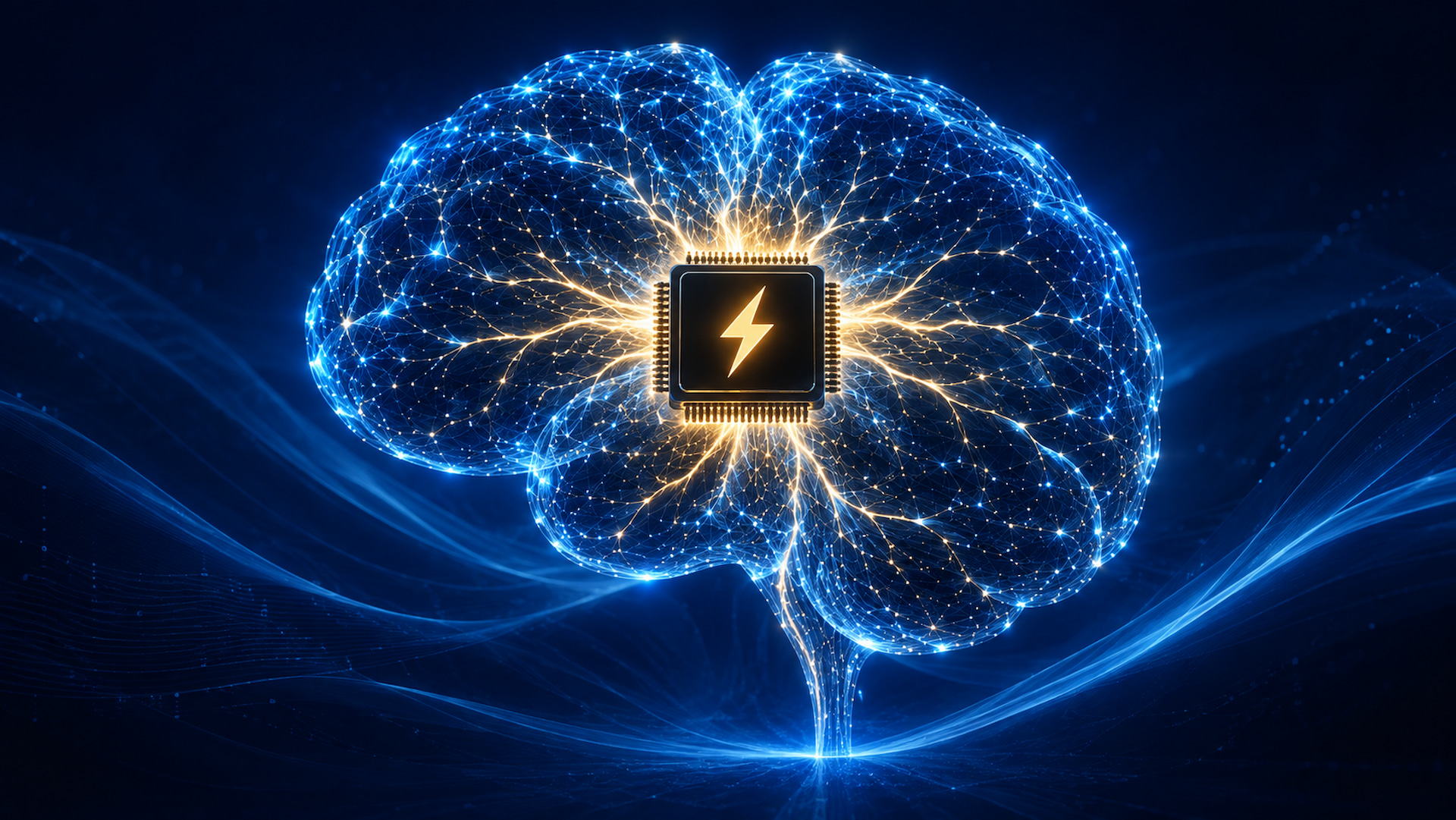
What emerged from that process is a nanoelectronic device that could reduce energy consumption in AI hardware by up to 70%. The mechanism behind it isn’t novel in concept, but the execution is. Rather than mimicking the logic of a standard processor, the device mimics the brain.
The human brain does not shuttle data between separate memory and processing units. It stores and processes in the same place, at the synapse, adjusting connection strengths based on experience. Neuromorphic computing tries to replicate that architecture in silicon. The problem has always been stability. Memristors, the components designed to behave like synapses, have historically been unreliable. The most common design uses conductive filaments that form and break inside metal oxide materials. Those filaments behave unpredictably, demand high voltages, and vary from device to device in ways that make large-scale deployment impractical.
Bakhit’s team went a different direction. They engineered a hafnium oxide thin film, modified with strontium and titanium, grown through a two-step process. The result is a device that switches states not by forming and breaking filaments, but by adjusting the energy barrier at the interfaces between layers, what physicists call p-n junctions. The resistance changes are smoother, more controlled, and far more consistent.
“Filamentary devices suffer from random behavior,” Bakhit said. “But because our devices switch at the interface, they show outstanding uniformity from cycle to cycle and from device to device.”
The performance numbers support that claim. Switching currents run roughly a million times lower than those of conventional oxide-based memristors. The devices support hundreds of stable conductance levels, which is the property that makes analogue in-memory computing possible. In lab tests, they held their programmed states through tens of thousands of switching cycles and retained information for approximately a day.
They also replicated something more interesting: spike-timing dependent plasticity. That’s the biological process by which neurons strengthen or weaken connections depending on the timing of signals, the physical basis of learning. Reproducing it in a synthetic device, reliably and at low power, is what separates a laboratory curiosity from a viable AI substrate.
“These are the properties you need if you want hardware that can learn and adapt, rather than just store bits,” Bakhit said.
The obstacle that remains is temperature. The current fabrication process requires around 700 degrees Celsius, which exceeds what standard semiconductor manufacturing typically tolerates. That gap matters enormously. A device that can’t be produced using existing industry infrastructure stays in the lab, regardless of how well it performs there.
Bakhit acknowledges this directly. His team is now focused on bringing that temperature threshold down. “If we can reduce the temperature and put these devices onto a chip,” he said, “it would be a major step forward.”
The research was supported by the Swedish Research Council, the Royal Academy of Engineering, the Royal Society, and UK Research and Innovation. Cambridge Enterprise, the university’s commercialisation arm, has filed a patent application.
Whether the temperature problem gets solved determines what this work becomes. Right now it’s a result. If the fabrication constraints can be resolved, it becomes infrastructure, the kind that quietly reshapes what AI systems cost to run.
AI Could Save the Planet, If It Can Get the Power to Do It
A major LSE study says AI could cut emissions by billions of tonnes annually — but only if it gets enough clean electricity. Where does that power come from?

When a Machine Has a Seat at the Table: A Conversation with Holger-Thorsten Schubart
What changes when AI moves from background infrastructure into an explicitly named position inside a scientific and industrial organization? Ten pointed questions, unabridged answers.
Neutrino® Energy Group Establishes Neutrino Engineering District to Move Scientific Consistency Toward Industrial Infrastructure
New global initiative brings physics, materials science, engineering, artificial intelligence, industrialisation and professional training into a distributed architecture built around one objective: turning validated physical effects into reproducible systems.